






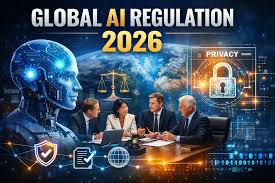
Artificial intelligence regulation has become one of the most critical global debates in 2026, as governments across the world move rapidly to introduce new laws aimed at controlling the fast-growing technology.
From Europe to Asia and North America, policymakers are now trying to strike a balance between encouraging innovation and protecting societies from the risks associated with AI systems. The result is a fragmented global landscape, where different regions are adopting sharply contrasting approaches to regulation, creating uncertainty for businesses and raising questions about the future of global cooperation.
A Rapid Shift from Innovation to Regulation
Just a few years ago, artificial intelligence was largely seen as a tool for innovation and economic growth. Today, the conversation has shifted dramatically toward governance, risk, and accountability.
In fact, dozens of AI-related laws have already been introduced worldwide in recent years, reflecting growing concern about the technology’s societal impact.
Experts say 2026 marks a turning point, as countries move beyond drafting policies and begin actively enforcing them.
This shift is being driven by several key concerns:
- The rise of generative AI tools capable of creating realistic content
- The spread of misinformation and deepfakes
- Data privacy and surveillance risks
- The potential impact on jobs and economies
As AI systems become more powerful and widely used, governments are under increasing pressure to act.
Europe Leads with Strict AI Laws
The European Union remains at the forefront of global AI regulation with its landmark AI Act, widely considered the world’s most comprehensive legal framework for artificial intelligence.
The law introduces a risk-based approach, classifying AI systems into categories ranging from low-risk to “unacceptable risk,” with stricter requirements for high-impact applications such as healthcare, finance, and public infrastructure.
Under the framework:
- High-risk AI systems must meet strict transparency and safety standards
- Certain uses of AI, such as social scoring, are banned
- Companies face heavy penalties for non-compliance, reaching up to 7% of global revenue
Implementation is being rolled out in phases, with major obligations taking effect from 2026 onward.
At the same time, European lawmakers continue to refine the law. Recent proposals include tighter restrictions on harmful AI applications such as deepfake content, reflecting ongoing concerns about misuse.
Despite its strong stance, the EU also faces criticism from industry leaders who argue that strict regulation could slow innovation and reduce competitiveness.
United States Takes a Fragmented Approach
In contrast to Europe’s centralized strategy, the United States has adopted a more decentralized and flexible approach to AI regulation.
Rather than introducing a single comprehensive law, the US relies on a mix of:
- Federal guidelines
- State-level legislation
- Sector-specific rules
This approach allows for greater flexibility and encourages innovation, but it also creates inconsistencies across different regions and industries.
Recent developments highlight the complexity of the US position. The government has been actively debating how to regulate key aspects of AI, including the export of advanced AI chips and infrastructure, which are seen as critical to maintaining technological leadership.
However, disagreements within policymakers have slowed progress, reflecting the broader challenge of balancing national security, economic interests, and technological advancement.
China Expands State-Controlled AI Governance
China has taken a distinctly different approach, focusing on strong state oversight and centralized control of AI development.
The country has already introduced multiple regulations governing:
- Generative AI services
- Algorithm transparency
- Content labeling and user protection
For example, new rules require AI-generated content to be clearly labeled, aiming to combat misinformation and protect users.
China has also promoted its own global AI governance initiatives, positioning itself as a key player in shaping international standards.
This model prioritizes stability, security, and control, but it has raised concerns about censorship, surveillance, and limited transparency.
Asia and Emerging Markets Join the Race
Beyond the major global powers, countries across Asia and other regions are accelerating their own regulatory efforts.
South Korea, for example, recently introduced one of the world’s most comprehensive AI laws, requiring:
- Human oversight in high-risk AI applications
- Mandatory labeling of AI-generated content
- Clear accountability for developers
Meanwhile, countries in Latin America and the Asia-Pacific region are actively developing frameworks tailored to their economic and technological needs.
This growing wave of legislation highlights the global scale of the issue and the urgency with which governments are responding.
A Fragmented Global Landscape

One of the biggest challenges facing AI regulation today is the lack of a unified global framework.
Different regions are pursuing different priorities:
- Europe: Focus on ethics, safety, and human rights
- United States: Emphasis on innovation and market-driven growth
- China: Strong state control and security
This fragmentation creates significant challenges for global companies, which must navigate multiple regulatory systems simultaneously.
Businesses operating across borders are now required to:
- Adapt AI systems to different legal requirements
- Implement complex compliance strategies
- Monitor constantly evolving regulations
As a result, many experts warn that inconsistent rules could slow global innovation and create barriers to international cooperation.
The Innovation vs Regulation Dilemma
At the heart of the global debate lies a fundamental tension: how to regulate AI without stifling innovation.
Supporters of strict regulation argue that strong rules are essential to:
- Protect users from harm
- Ensure transparency and accountability
- Prevent misuse of powerful technologies
Critics, however, warn that excessive regulation could:
- Slow technological progress
- Increase costs for businesses
- Limit competitiveness in the global AI race
This tension is particularly evident in Europe, where policymakers are trying to balance technological development with the protection of fundamental rights.
Growing Calls for Global Cooperation
As AI continues to evolve, there are increasing calls for international cooperation to create shared standards and avoid regulatory fragmentation.
Some progress has already been made, including agreements between multiple countries to establish common principles for AI governance, focusing on human rights, transparency, and accountability.
However, achieving true global alignment remains a major challenge due to:
- Geopolitical competition
- Differences in political systems
- Conflicting economic priorities
Experts warn that without coordination, the world could face a future where AI development is divided into competing regulatory blocs.
What It Means for the World
The outcome of the global AI regulation debate will have far-reaching consequences for economies, industries, and everyday life.
For businesses, it means adapting to an increasingly complex regulatory environment. For governments, it requires balancing innovation with responsibility. And for individuals, it raises important questions about privacy, security, and the role of technology in society.
As 2026 unfolds, one thing is clear: artificial intelligence is no longer just a technological issue — it is now a global policy priority shaping the future of the digital world.